
The Coalition of Tactical Voting Was Always Going to End in a Bin
Trust in politicians is about as low as it has ever been measured. The Electoral Commission’s 2025 survey found just 14% of people say they trust politicians — itself only a slight recovery from 10% the year before. The British Social Attitudes survey put trust in government to act in the national interest at a record-low 12%, and Ipsos’s long-running Veracity Index found only 9% of Britons trust politicians to tell the truth.
Into that vacuum steps Clacton.
Nigel Farage has resigned as MP for Clacton in order to trigger a by-election and stand again — a move announced on 7 July, off the back of mounting scrutiny of his finances, including a £5 million gift that has reportedly been flagged to the National Crime Agency, and a live Parliamentary Standards Commissioner investigation into whether he failed to declare it. Farage’s own framing was that he wanted “the people of Clacton” — not the press, not Parliament — to be “the judges of my actions,” casting the contest as “a people versus the establishment by-election.”
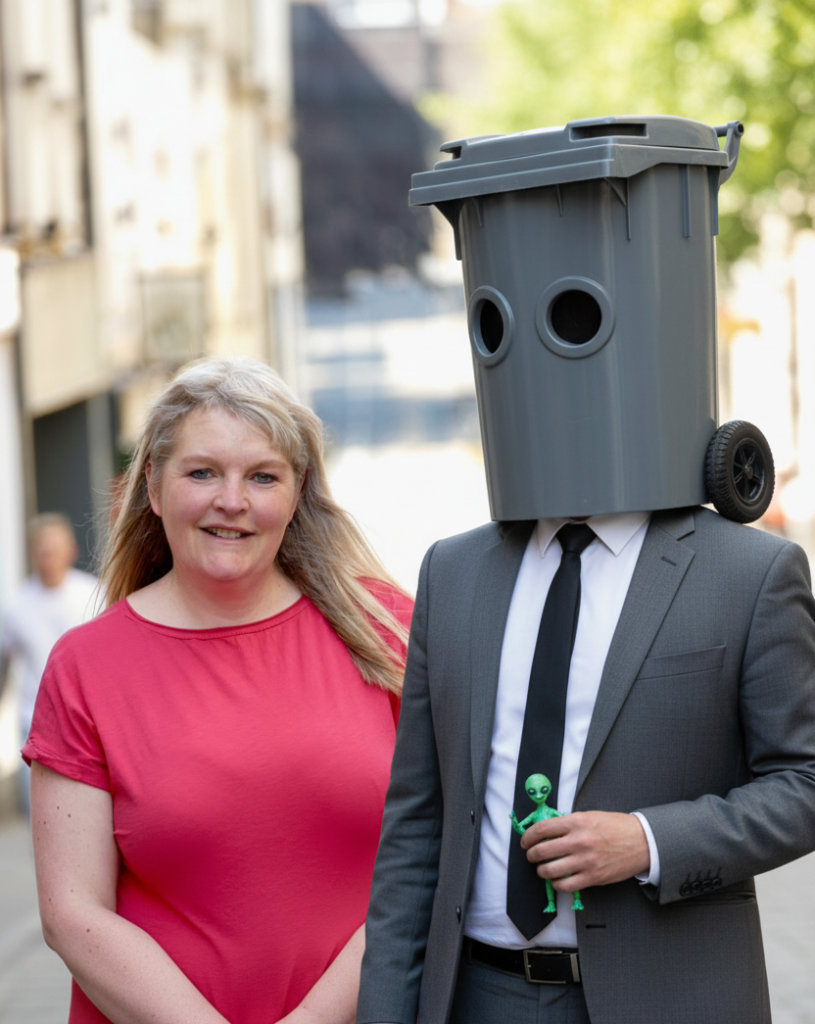
The other main parties took one look at that framing and declined to play the game — Labour, the Conservatives, the Lib Dems and the Greens have all said they won’t contest a stunt. Into the space they left has stepped a satirist in a costume: Count Binface.
And it’s not just a joke doing the rounds online: a snap Ipsos poll found that nationally, 33% of the public would prefer Count Binface to win the seat, against just 21% for Farage — a 12-point lead for a costumed satirist, even though only Clacton’s voters get an actual say.
The same week, a YouGov poll found 73% of Britons consider Farage at least “fairly sleazy,” with 56% going further and calling him “very sleazy” — a rating worse than the public gives the previous Conservative government. Into that vacuum steps Clacton, and a summer where the most credible-looking alternative to the self-titled anti-establishment candidate is, literally, rubbish.
I stood as the Liberal Democrat candidate for Bridgwater in the 2024 general election — a campaign called with just six weeks’ notice. On day one, before I’d had the chance to tell voters what I stood for, or what I’d do if elected, the tactical voting trackers had already started moving. The “beat the incumbent” counter pointed to me for about a day, then switched to Labour — the coalition of tactical voting still finding its feet, and already binning me in the process. Within the first 48 hours, polling had effectively told voters I couldn’t win — before the GE campaign had practically begun.
So while the machine was busy deciding who deserved my votes, I did what I always do: I focused on the people in front of me. During my GE campaign I worked with the Pawlett Hams community to fight EDF — a stretch of ancient farmland and community space near Bridgwater that EDF had earmarked for a giant saltmarsh, that would wipe out natural habitat. It took a genuinely David-and-Goliath community campaign, but EDF backed down. That’s the kind of work that doesn’t show up on a tactical voting tracker, but it’s the actual substance of representing a place. That felt like a win!
Before any of that, though, there’s a stage most voters never see: selection. To even get onto a general election ballot as a party candidate, you have to be selected. Different parties have different ways of selecting candidates. It is its own gruelling mini-election. If you want to understand how strange and demanding that process really is, read Rory Stewart’s Politics on the Edge — his memoir is unusually candid about both the absurdity of Conservative candidate selection and the grinding reality of life as a backbench MP. Even the politicians who go on to lead the country rarely get selected at the first try.
Then the general election machine starts, and yes, you use the tools available — the door-knocking, the leaflets, the long days. But there’s a tipping point where the giant apparatus of tactical voting trackers, polling, online trolls and algorithms starts to drown out the candidate herself: who she is, what her story is, why she’d actually be good at the job. And doing that in six weeks, with limited resources, is a tall order.
Many of us will watch politics in Clacton this summer with the mix of humour and strange pride the British reserve for our eccentrics (Binface, that is). But underneath the joke is something more serious: a reflection of just how broken our electoral system has become. And unless something changes, more of us — voters and candidates alike — are going to keep finding ourselves facing the bin.