
Listening to Croscombe: What a Village’s Road Works Reveal About Highways Resident Communication
I have asked for a review of the A371 road works (Croscombe to Shepton Mallet) at the Highways Improvements Board at Somerset Council. The Board was established by the Leader of the Council to give local councillors a direct route to raise concerns and to ensure residents feel heard. While there are many road projects that go well, and the highways team work hard to deliver them, it is important that when things don’t go to plan, there is a proper process to learn from that experience.
A Note from Claire Sully
I am a local councillor, and I live in the village of Croscombe. Like many of my neighbours, I have experienced the road works on Long Street and the A371 corridor between Shepton Mallet and Wells firsthand, and shared the frustrations that came with them.
I wanted to capture what that experience has actually been like for the people who live here. Much of what passes happens through emails back and forth with service officers — and important details, concerns and feelings can get lost along the way. I hope that by putting this on record properly, we can use it constructively at Somerset Council: to improve how highway works are communicated, managed and completed in communities like ours.
In this piece I am not writing as a councillor. I am writing as a resident. My neighbour Terri shares her experience below, in her own words. — Claire Sully, Croscombe resident
Terri’s Account
Phase One: The Night Works — February
The first phase of disruption came in February, when the road was closed for several days. I run The Cross — an award-winning bed and breakfast here in Croscombe — and during the road closure I was unable to take any bookings, as it would have been unreasonable to expect guests to find their way to my B&B. I therefore lost business and income during this period.
The works themselves took place in the evening and into the night — Kanga drills, flashing lights, motors running. This is a residential street. The noise was completely unacceptable and it would have been impossible for any of my guests to sleep through.
Phase Two: Chippings — April
Then came the chippings in April. The grit was extraordinary — it was like the sands of the Sahara. Everything was covered in dust, along the whole street, on the pavement even. My car got chipped, the windscreen, and there was grit ground into everything. But we accepted it. We know what surface dressing involves, and over time the chippings embedded into the road. We got on with it. That’s what you do.
Phase Three: The No-Show — May
In May signs appeared again saying we couldn’t park on the main street. So everybody moved to the side streets, which caused congestion and its own set of problems for people trying to get in and out. Someone in the village had even moved their house move date, so not to clash with the road works. We were told the works would start at 9:30 in the morning, on May 8th. Then May 9th, they didn’t. And we were never told why not.
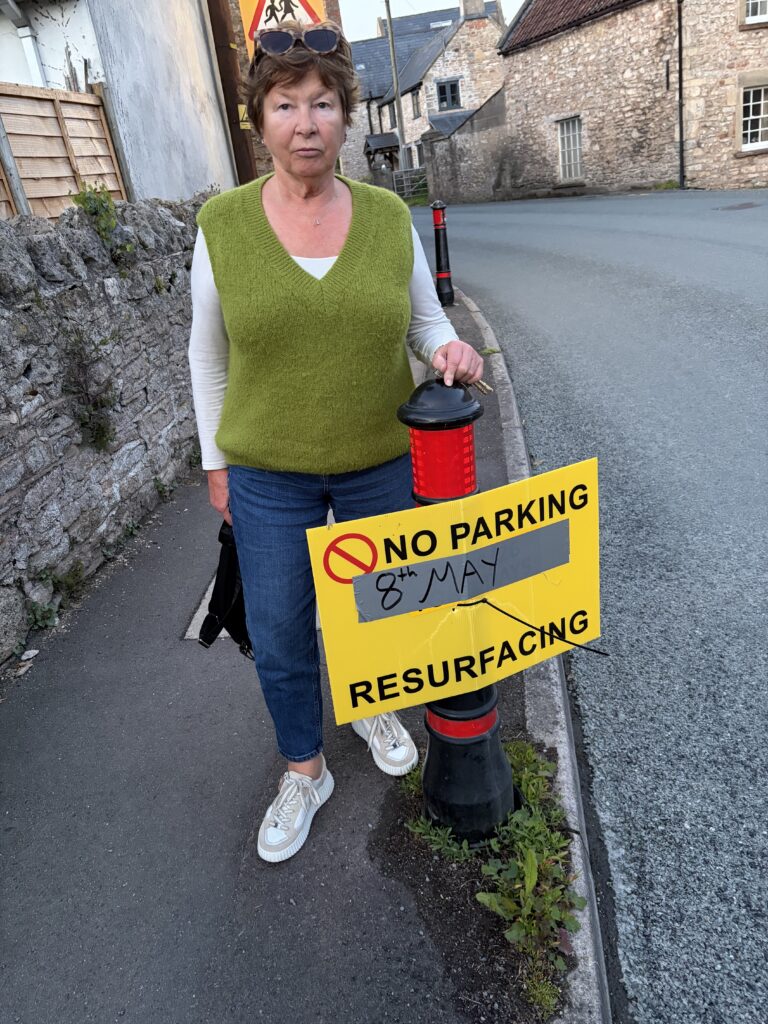
I phoned Somerset Council to find out what was happening. The lady in the office was absolutely adamant that the work had started. I told her it hadn’t. Nothing was happening — there was nobody out there, no machinery, nothing. She was none the wiser. She had no information to give me, and I had no way of finding out when, or if, anyone was coming.
So there we were. Main road closed to parking, side streets clogged up, and not a worker in sight over that weekend.
As I speak to you, it is the 13th of May. The road has no markings. None. It’s been surface dressed but it doesn’t feel finished — the section towards Shepton Mallet is as bad as it ever was. There’s a significant bend along that stretch where you can clearly see a gap in the works [from 1 min 52 s] — a section that simply wasn’t treated at the same time as previous works. It sits between the work done at our end of the village and the work done from the Shepton end, and it stands out. You can’t miss it. Councillor Martin Lovell has been receiving complaints about why that section was left, and rightly so. And there are black skid marks appearing on the surface now, which suggests the top layer is already wearing down. That’s not a good sign.
The matrix signs — the electronic warning signs on the approaches from the Wells direction of the A371 and from the Shepton side — those have been taken down now. And with them gone, there is absolutely nothing to tell drivers, or residents, or anyone, what is happening next. No indication that anyone is coming back to complete it. No word about when the road markings will be reinstated. The only thing still standing is the original sign — dated May 8th — notifying of the road closure and the no-parking restriction. It wasn’t collected.
And that brings me to what I find perhaps the most frustrating part of all of this. There has been a lack of communication. No clear advice regarding the disruption and works involved. They have not kept to their schedules and the highways department didn’t have up-to-date information. We still have a sign up saying the road will be closed May 8th.
This account was recorded by Claire Sully, local councillor and Croscombe resident, as part of an effort to document community experience of highway works and improve communication between Somerset Council, its contractors, and the residents they serve.
A video is available of the recent works on the A371 to illustrate some of the commentary above. The missing part of the road can be seen from 1 min 52 secs.