
Remind me why they sold Shepton Mallet Prison?
Why the prison crisis on this week’s front pages started here, in Shepton Mallet, on 10 January 2013 — and why the Conservatives don’t want you looking that far back.
Open any news app this week and the prison crisis is the top story. Release dates moved and moved again. Exemptions redrawn. A Prime Minister publicly pushing his Justice Secretary to find headroom in the estate. Talk of housing men in women’s prisons, of accelerating deportations, of releasing IPP prisoners. Families of victims put through the wringer while ministers work out who is covered by which scheme.
Some of the criticism of the current Government is fair; a policy that has to be paused, reviewed and redrawn twice inside a month is not one anyone should be proud of.
But I want to ask a different question, because it is the one nobody in Westminster will ask. Why did they close Shepton Prison? Not last month. Not last year. Here, in Shepton Mallet, on 10 January 2013.
The beginning of the end
On 10 January 2013, the Conservative Justice Secretary Chris Grayling announced that seven prisons in England would close. Shepton Mallet was on the list.
Eleven weeks later it was over. The Union Flag came down. The bells rang out for an hour and a half. A Royal Navy Lynx flew over from Yeovilton. More than 200 staff, past and present, marched to parade inside the main gates in full dress uniform, medals and all, and were dismissed for the last time by the Bishop of Bath and Wells. The last governor took the flag.
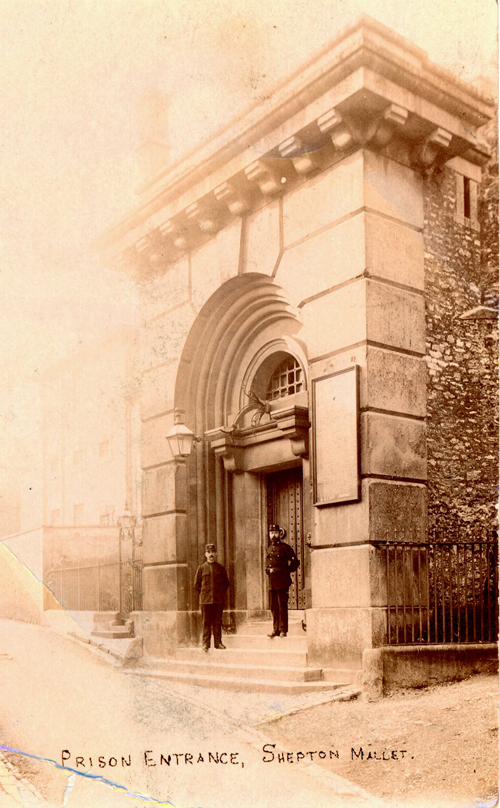
Four hundred years of unbroken use, ended by a spreadsheet.
Let me be precise, because the point gets lost: this was a Conservative Government decision. Ministers in Whitehall decided that Shepton Mallet Prison — established as a House of Correction in 1625, and by 2013 the oldest working prison in the United Kingdom — was surplus to requirements.
The reason given was money. The Ministry of Justice expected to save £63 million a year by driving down the cost of running what it called “old and uneconomic” prisons. Across the seven closures that meant losing 2,600 places and putting 1,177 staff through redeployment or redundancy. Shepton’s 189 men — most serving life for murder, the rest long sentences for serious sexual offences — were dispersed around the estate.
Close the small and ancient, build the vast and modern. Simple.
So — did they ever build the super prisons?
I’ve gone back and checked, because this is the part everyone forgets.
Partly. Eventually. Nothing like as promised.
The same announcement that killed Shepton Mallet promised a 2,000-place “super prison”. That one did get built: HMP Berwyn opened at Wrexham in February 2017, around £250 million, capacity 2,106. It is also, according to the Howard League, a prison built in breach of the UN minimum standard on single cells — around 60 per cent of its cells were designed for two.
Then came the bigger promise. In 2015 the Conservative Government announced nine new prisons. In 2016 the Conservative Chancellor George Osborne promised 10,000 new places by the end of 2020. By September 2020 the Public Accounts Committee reported that 206 had been delivered. It called this a staggering failure, and found a maintenance backlog of more than £900 million, with around 500 places falling permanently out of use every year.
The programme was rebadged as 20,000. Five Wells opened in 2022, Fosse Way in 2023, Millsike in March 2025.
And where did that leave us? In March 2025 the Public Accounts Committee warned the justice system faced “total gridlock” — the point at which courts cannot sentence people because there is nowhere to put them. The adult male estate had been running at up to 99.7% occupancy. A quarter of prisoners were sharing cells designed for one, often with an open toilet. In September 2024 the population hit an all-time high of 88,521 and around 1,700 people walked out early.
For context: when the closures were announced, the prison population in England and Wales stood at 83,632 against an operational capacity of 90,451. There was headroom — and ministers chose that moment to take 2,600 places out of the system. Today the population runs around 87,000 against an estate designed for roughly 70,000. And Public Accounts Committee most damning finding, for our purposes: overcrowding forces prisons to concentrate on averting disaster rather than on rehabilitation.
Which brings me to the thing that still makes me cross.
Shepton Mallet Prison was a good prison
The evidence: HM Chief Inspector of Prisons carried out a full announced inspection over five days in June 2010. The report was, in the Chief Inspector’s own framing, a very positive one — testament to what a small-scale niche prison with a settled population could achieve. Despite an ageing environment, inspectors found it a very safe place, with positive staff–prisoner relationships and a serious focus on the risks the population presented. Low levels of self-harm. Low levels of bullying, violence and drug use. The accommodation was old and tired but adequate for the numbers held — and inspectors specifically warned against proposals to cram in another 70 men.
Howard Hardman, a probation officer who first visited in 1971, put it plainly to the BBC on the day it closed: Shepton Mallet and Kingston in Portsmouth were the top two performing prisons in the country on the last round of inspections in 2010. Both were on Grayling’s list.
Why did it work? Scale. Roughly 36 uniformed officers to 189 men, in a small market town, over a long period. Everybody knew everybody by their first name.
You cannot build that. You certainly cannot build it in eighteen months on an industrial estate. It takes decades of dedicated staff doing unglamorous work well, and it can be destroyed in eleven weeks by a press release.
Why did they really close it?
Because it was small, old, listed, and — crucially — worth something on the open market.
The savings case was always thin. Once closed, the mothballed prison cost the taxpayer more than £140,000 a year just to sit there. The MoJ then made a mess of selling it: the deadline for a preferred bidder slipped from March to August 2014, the local proposals were rejected in October, and in December it went to City & Country as a package with Dorchester, Gloucester and Kingston — assessed, the MoJ said, as best value for the department and the taxpayer. The price has never been disclosed.
Note what that phrase does and does not contain. It does not contain the words “Shepton Mallet”. The sale was agreed on a developer’s track record, not on any plan for our town.
I asked for community consultation. Hundreds of people signed my petition. The MoJ refused. We were told we could have our say at the planning stage — a proposition Tessa Munt MP called disingenuous at the time, since the grounds for refusing an application are narrow and any competent applicant knows how to draft around them, she said.
What the town wanted was mixed use: heritage attraction, community and performance space. Shepton has a critical shortage of space — sports clubs with nowhere to train, drama groups folded for want of a rehearsal and performance space. A 400-year-old walled site in the middle of town was the obvious answer to a question.
Instead we got a decade of uncertainty. City & Country are a developer; converting listed buildings into homes is what they do, and consent for accommodation inside the walls was approved in 2021. Running the site as a visitor attraction from 2017 was somebody else’s business: Cove are leisure operators, and they were the tenant, not the owner. The attraction was announced for closure in November 2023 after the relationship broke down, then reprieved three days before Christmas. In February 2025 Cove bought the freehold.
So the developer who bought it to build homes in it spent ten years not building homes in it, and then sold it to the people running the ghost tours. I have a theory about that. See below.
The site is open to the public and there is no housing inside the walls. What happens next is a matter for its owners and, in time, the planning system. That is a separate argument, and I’ll leave it where it belongs.
Because the question I keep coming back to isn’t who owns it. It’s whether any of this needed to happen at all.
But should it have been closed?
I have been accused of caring about this place too much. It is a gaol. It is grim. I know. Guilty. I have written about it, researched the men hung and buried inside it, and argued its heritage case in public since 2013.
But I want to separate two things: The heritage argument and the penal argument are not the same argument. You can think a 400-year-old listed gaol deserves to survive and still think it should have stopped being a working prison. The buildings were old, the sanitation was old, single-cell provision was inadequate, and the Chief Inspector had questioned the site’s future as far back as 1992.
So, honestly: should it have closed?
Not like that. Not then. Not for those reasons.
If the case had been made on decency — we should not hold men in nineteenth-century accommodation, and here is the modern place they are going to instead — I could have argued it on the merits. That is a real debate about what we expect prison to achieve.
That is not what happened. It closed to save £63 million a year, before the replacement capacity existed, on the assumption that a building programme would materialise. It didn’t.
And the specific thing destroyed at Shepton Mallet is the thing the whole system now says it most badly lacks: a small, settled, well-inspected unit, where violence and self-harm were low.
What we lost was not a heritage asset. That survived, more by local persistence than by design. What we lost was 189 places and a working culture that took forty years to build.
Where the roots are
Every emergency measure in the news this week — the release points, the exemptions, the recall changes, is downstream of decisions taken between 2013 and 2024 by Conservative ministers. Grayling closed 2,600 places without the replacements being ready. Osborne promised 10,000 more and delivered 206. Successive Conservative justice secretaries let the maintenance backlog build until 500 places a year were falling out of use through neglect, while sentence inflation pushed the population up and the courts backlog filled the remand wings.
By the time the Conservatives left office the estate was at 99.7% capacity and they were already releasing prisoners early themselves — 10,000 of them, up to 70 days ahead, under a scheme announced in March 2024.
Whatever you think of how the current Government is handling it, no justice secretary taking office in 2024 could have built their way out of that in two years.
So when you hear a Conservative frontbencher this week demanding to know why the Government is releasing prisoners early, the honest answer is: because your party sold the prison that was doing this job properly, promised replacements it never built, and left the estate with no room to fail.
They sold ours, in Shepton, in a job lot with three others and would not even talk to the town about it.
My connection
Mine goes back a long way, and it isn’t only political.
I wrote The Hangman Tales – the Mild-Mannered Australian Soldier, an imagined account of the true hanging of Verney Asser at Shepton Mallet on 5 March 1918, built from original testimony, the memoir of John Ellis — England’s official executioner, and the man who hanged Verney — and recollections passed down my family. My Dad’s grandfather witnessed Verney’s hanging.
I’ve also appeared on BBC One’s Murder, Mystery and My Family, and I took part in the radio interview with City & Country’s managing director on Christmas Eve 2014, when we were still trying to get anybody to promise the town a hearing.
Verney Asser is still there, buried inside the walls alongside the other men hanged between 1889 and 1926, in unmarked graves, as was the custom. That is not a heritage detail. That is six or seven men in the ground under a site that was, for a while, earmarked for luxury flats.
And now the ghosts
Seven civilian executions between 1889 and 1926. Eighteen American servicemen executed between 1943 and 1945, sixteen hanged in a red-brick block bolted onto the side of a wing, two shot by firing squad in the yard. Thomas Pierrepoint did most of them, assisted by his more famous nephew Albert, who disapproved of the American habit of making a condemned man stand on the trapdoor while his charge sheet was read out. Those eighteen were exhumed in 1949 and most reburied in Plot E at Oise-Aisne — the plot the US Army reserved for the dishonoured dead, where the graves carry numbers and no names.
Amelia Dyer served six months here in 1879. The Krays were held here in the early 1950s and met Charlie Richardson while they were at it. During the war the prison held 300 tons of the nation’s memory — the Domesday Book, the logbooks of HMS Victory, the Waterloo despatches — stacked up in a Somerset gaol while Bath and Bristol burned. The gallows came out in 1967 and the room became the prison library. Men sat and read where men were hanged.
I make no claims about what walks the wings at three in the morning. But I have met enough people who do. What I will say is this: an awful lot of people died very badly inside those walls, several are still in the ground there, and every one of them was somebody’s child.
And here is my theory. City & Country bought this site to convert into homes. They had a decade, a planning consent and every commercial reason to get on with it. They didn’t. They sold it to a leisure company instead.
I think the building saw them off.
You can market a converted mill, a converted chapel, a converted asylum if you’re brave. It is a harder sell to write the particulars for a two-bedroom apartment overlooking an exercise yard with six or seven unmarked graves in it, a hundred yards from an execution shed (bullet marks still on the walls). The heritage that made it worth saving is the same heritage that makes it very difficult to sell as somewhere to have your morning coffee.
The dead men and women of Shepton Mallet may have done more to protect this site than the Ministry of Justice ever did.